The Growing Good Fruit Tree began with an idea from our son.
We'd just returned to school after a break filled with travel, flexibility and rather less routine than usual. He mentioned that his class had a “Ready to Learn” ladder and thought something similar might help at home.
So we started with three pieces of coloured paper.
But the more I thought about it, the more I wanted something that went beyond managing behaviour. Behaviour matters, of course. Yet our children are not their behaviour. Their actions can tell us something about what is happening beneath the surface—what they're feeling, struggling with or learning to choose.
I also know how easily discipline becomes reactive when we haven't been proactive about expectations. I wanted a simple visual way to ask together: Where are we at, and what might a wise, loving next choice look like?
Why a tree, not a reward ladder?
I didn't want our children imagining they were climbing closer to God, earning more love or becoming more valuable than their siblings. God's love and our love aren't prizes for reaching the top.
A tree gave us a better picture. Psalm 1:1–3 compares the person who delights in God's instruction to a tree planted by streams of water, bearing fruit in season. Jesus tells His disciples that fruit comes through remaining in Him (John 15:4–5).
We want to cultivate character, not produce performances. Galatians 5:22–23 gives us the beautiful, practical language of love, joy, peace, patience, kindness, goodness, faithfulness, gentleness and self-control.
For Christians, these are the fruit of the Spirit, what He produces in us naturally (super-naturally) by design, rather than a checklist for earning God's approval. They also help us talk with all our children about loving God and others.
Loved in every zone
One principle is non-negotiable: our children are loved in every zone.
We might say, “I love you, but I don't love that choice.” One of our children finds correction especially upsetting, so we sometimes have them repeat after us, “Mum and Dad love me, and they want what's best for me. That's why they correct me.”
The purpose is reassurance: correction of an attitude or behaviour is not rejection of the child.
A zone describes present choices or a need for help, never a child's identity or standing before us as parents or God. Hugs, cuddles, laughter and quick reconciliation matter far more to us than the position of a name tag.
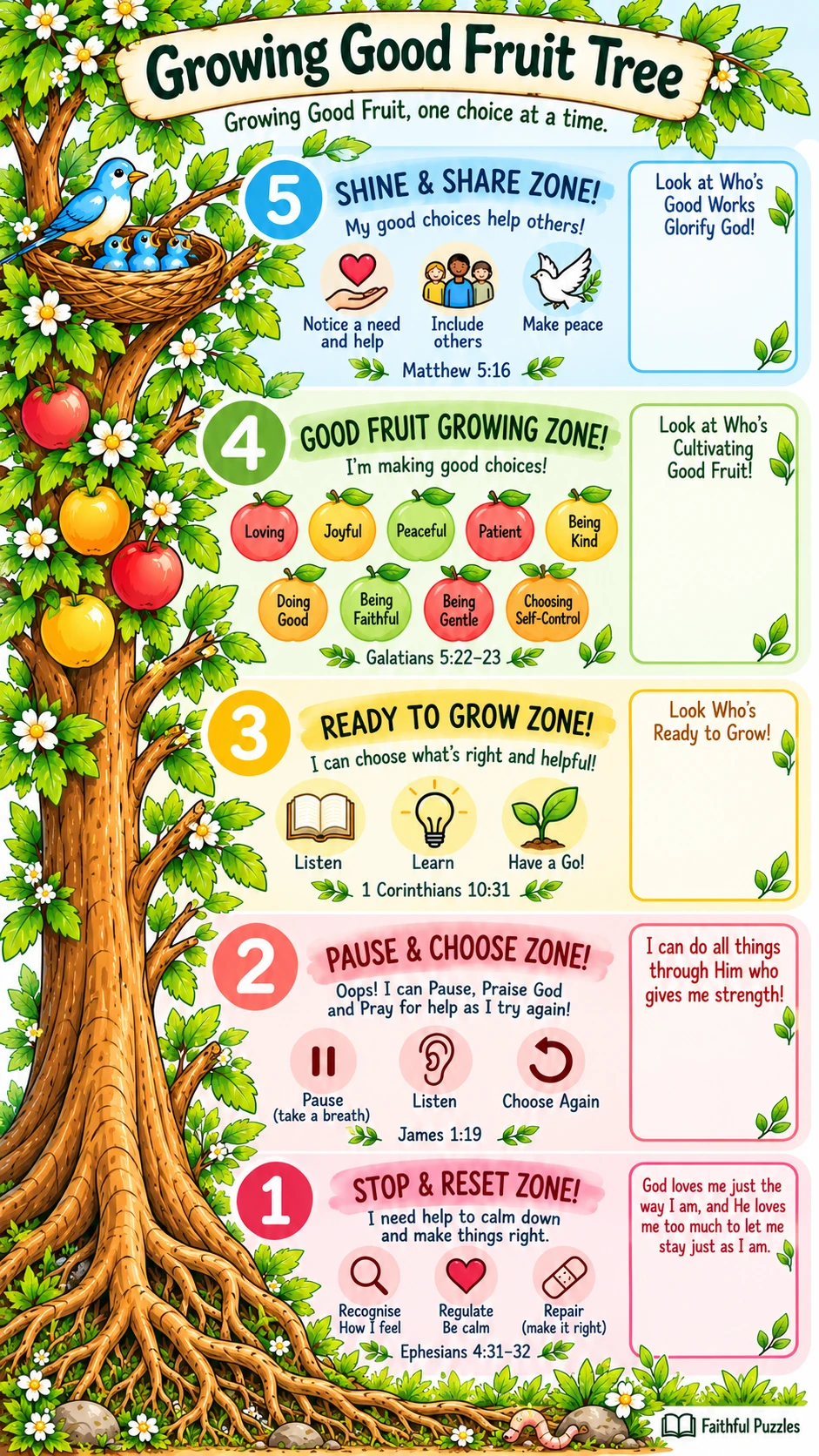
How the five zones work in our home
Zone 3 — Ready to Grow
Everyone begins here: “I can choose what's right and helpful!”
I like to sing the little “Look who's ready to grow” line while the kids put their name tags on. A bit of silliness helps. They've made up their own little dance which is really fun.
Zone 4 — Good Fruit Growing
When we notice consistent choices reflecting the Fruit of the Spirit, we encourage the child and invite them to move their tag.
Cue another song: “Look who's cultivating good fruit!”
We talk about the love, patience or self-control behind the action.
Zone 5 — Shine & Share
This is for going above and beyond—spotting a need, including someone, helping or making peace.
“My good choices help others!” we remind them.
We sing “Look whose good works glorify God,” because Matthew 5:16 directs the glory to our heavenly Father, not ourselves.
Zone 2 — Pause & Choose
This is our “Oops—I can choose again” zone.
Our three Ps are Pause, Praise, Pray: breathe, thank God for something, then ask for help to choose what is right.
That practice began with me, and I've tried—imperfectly—to model it for the children.
Zone 1 — Stop & Reset
Continued defiance or an action that could hurt someone may require direct parental intervention.
We help the child settle, take responsibility and make things right.
Our reminder is:
“God loves me just the way I am, and He loves me too much to let me stay just as I am.”
I often add, “And so does Dad.”
We parents decide when tags move, but often ask questions so the children can recognise their own choices. They move their tags at our direction.
Movement is generally one zone at a time, but we're quicker to help them move up than down.
Once a child in Zone 1 or 2 has reset and made things right, they can go straight to Zone 3. If they're still in one of those zones at bedtime, tomorrow starts afresh at Ready to Grow.
We don't want anyone stuck there.
When a child needs help, not another chart conversation
We've had fighting and hitting that called for some time apart to calm down and then a conversation about making things right.
I've asked, “What zone do you think that choice fits in? What zone do you want to put your name tag? What could you do to show you're ready?”
For us, repair is more than reciting “sorry.” We encourage our children to name what they did, understand whom they hurt, ask forgiveness specifically and think about a different choice next time.
Ephesians 4:31–32 gives us a biblical picture of putting away bitterness and responding with kindness and forgiveness.
Sometimes, though, everything is going downhill and the chart must wait.
A tired, hungry or overwhelmed child may need a snack, a cuddle, a walk, a jump on the trampoline or space to settle.
You don't use a screwdriver to spread butter.
And the tool doesn't do the parenting for you!
I've found counsellor David Thomas's Recognize, Regulate, Repair framework helpful: notice what's happening, help the child settle and then attend to what needs making right.
Often children need our calm presence before they're ready for instruction.
James 1:19 is a good reminder for the parent too: listen first, speak carefully and be slow to anger.
Growing fruit in ordinary family life
The tree works best alongside intentional practice.
In the laminated “I'm Cultivating…” space, we can write one aspect of the Fruit of the Spirit to focus on during the week, sometimes alongside a separate habit chart.
Take kindness: we don't want it to mean merely avoiding rude words. We encourage our children to look for someone who needs help, then do something loving.
With patience or self-control, we practise noticing when our emotional temperature rises and choosing a different response.
We even use a little physical exercise. We flex our arms, breathe in and say “self”; then we bring our hands together, release the tension, breathe out and gently say “control.”
It makes an abstract idea tangible.
I hear the heart of this in Deuteronomy 6:5–7.
God called His people to love Him wholeheartedly, keep His words on their own hearts and speak of them with their children at home, on the road, at bedtime and in the morning.
Breakfast-table conversations, dinner recaps and even sibling disagreements give us opportunities to talk about God's ways.
Proverbs 22:6 urges us to train a child in the way he should go. I take this as wisdom about patient, intentional formation—not a guarantee that parents can control every future choice.
Discipline is training, and training takes time.
I'm growing too
If I'm brutally honest, the tree helps me as much as, perhaps more than, our children.
As we talk about Scripture and character, I remember how much I prayed for them and what a privilege it is to guide these little image-bearers of God.
If I'm not walking in the Fruit of the Spirit, I can't pretend I'm in Zone 4.
I may not have a name tag, but I can ask my children where my choices would fit and give an honest assessment.
Their assessment is usually spot on.
And since more is caught than taught, it's helpful for me to have a reminder too.
We sometimes use Philippians 4:13: “I can do all things through Him who strengthens me.”
Paul's words come from learning contentment through both hardship and plenty. They're not a promise that every effort will succeed, but they do encourage believers to depend on Christ in every circumstance, and choose to be joyful which is a huge theme in Philippians.
There's your homework. ;-)
How to try the Growing Good Fruit Tree
Make it an art project!
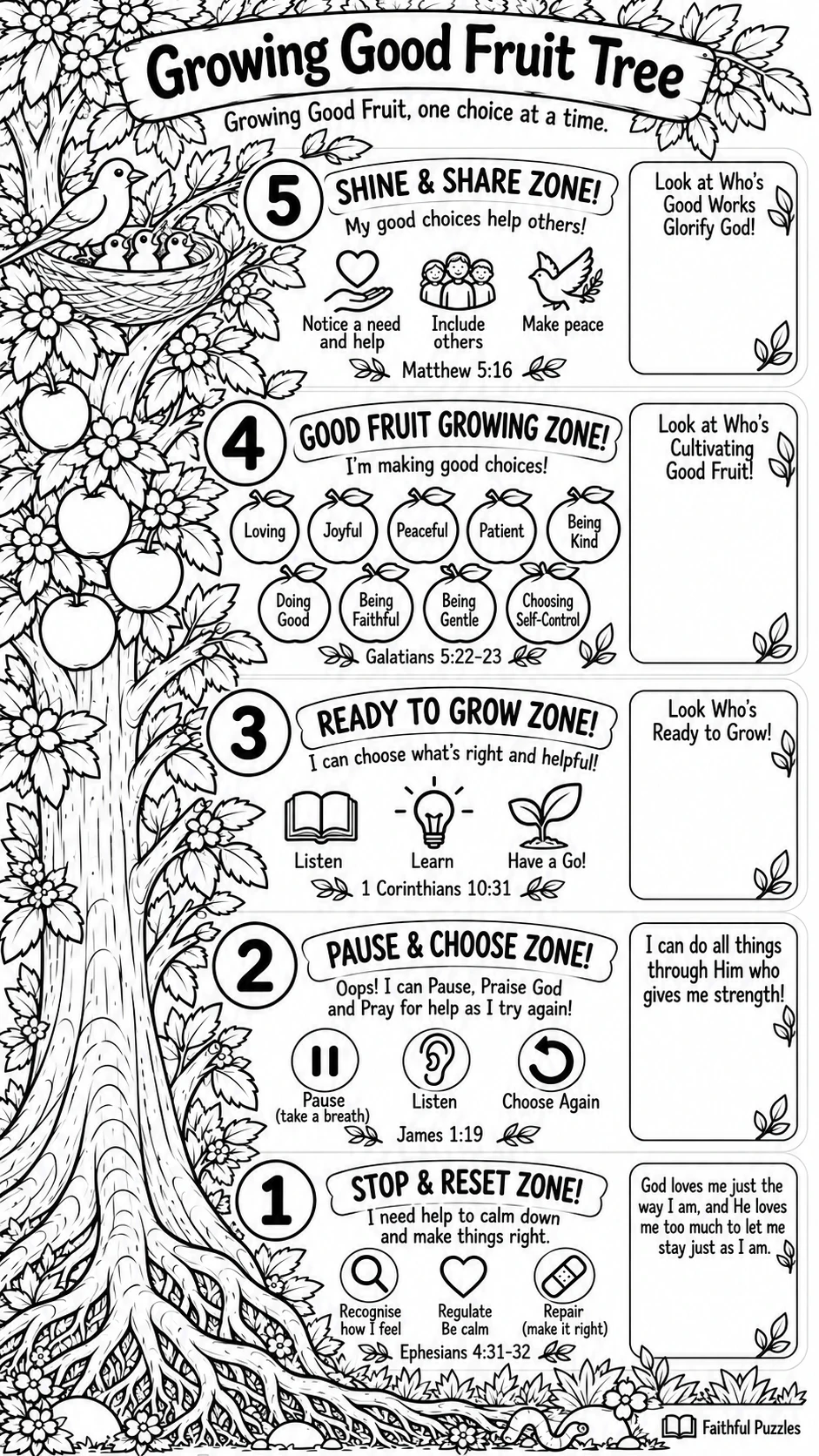
Print and assemble the Tree using the supplied artwork. We have full-colour and line-art versions, so children can enjoy colouring and personalising their own chart.
Let them colour the name tags, cut them out and help prepare everything for use.
Laminating the finished chart makes it easy to use a dry-erase marker in the “I'm Cultivating…” space.
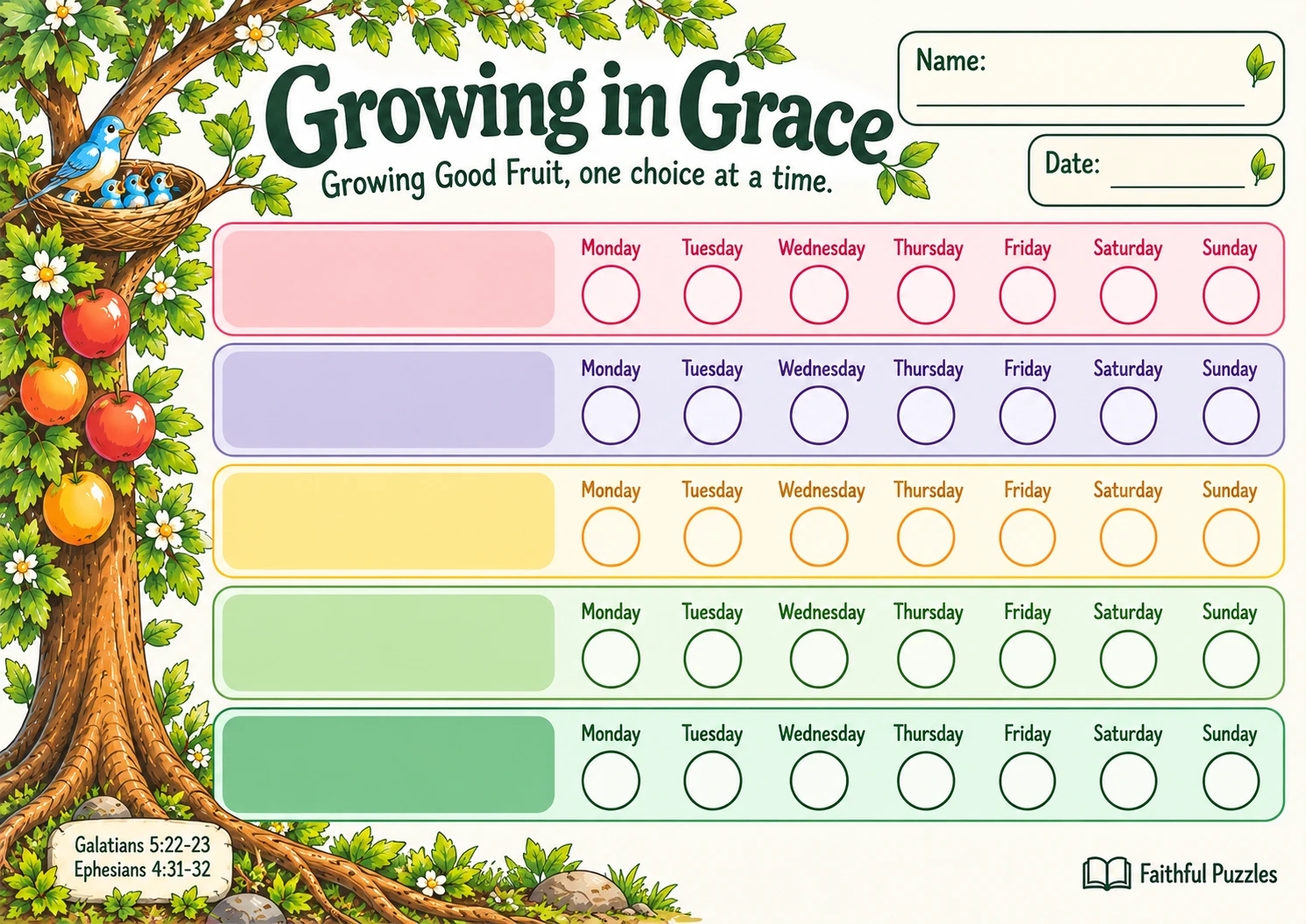
The companion Growing Good Fruit Tracker is a separate activity, with its own instructions on the reverse.
As you work, introduce the zones playfully.
Ask, “Would we expect kicking, screaming or complaining in the Shine & Share zone?”
Let the children suggest which choices fit where.
Read the chart's Bible passages yourself so you're ready for those conversations; reading together in one sitting will depend on your child's age and attention.
Try it for a week, be consistent for that trial and then adapt.
Breakfast and dinner can be natural opportunities to revisit the Fruit of the Spirit, and the companion Tracker can provide another practical way to encourage intentional choices.
If a child thinks the tree needs more pink—as ours did—hand them the colouring pencils!
We haven't used the tree long enough to claim lasting results. But it has already given us something concrete to point to and a shared language for growth.
Quick questions parents ask
What if my child dislikes the chart?
Make it playful, try a short trial and involve them in personalising it. If it creates discouragement, try a different approach.
Do we move a tag for every mistake?
No. Consider tiredness, overwhelm and what help your child needs. Sometimes the chart can wait.
Can we give rewards?
We may use rewards with a separate Fruit of the Spirit habit chart. The tree itself is not a way of earning approval.
What about different ages or needs?
Simplify the words, adjust your expectations and offer appropriate support. Never compare siblings or make correction humiliating.
The chart isn't the Bible or a substitute for loving, intentional parenting.
It's a tool, not the tutor or teacher.
We get to guide our children with Scripture, song and silliness, remembering that we're growing too.
And where the Holy Spirit is at work, growth is not merely formative; it can be transformative.
Bring the Growing Good Fruit Tree into your home
Want to try it with your family?
Get the Growing Good Fruit Tree printable and begin with one conversation, one helpful choice and plenty of grace.
More resources for parents
Go deeper into the Fruit of the Spirit
We're planning a Fruit of the Spirit Guided Study to help parents explore Galatians 5:22–23 more deeply and share what they're learning with their children.
The study will introduce inductive Bible study, encourage Word and Concept Studies of the nine aspects of the fruit of the Spirit, and provide simple Dinner Table conversations for family discipleship.
The aim is to help you understand God's Word for yourself and bring it naturally into everyday family life.
Fruit of the Spirit Guided Study · Coming soon
In the meantime, you can read and study Galatians 5:13–26 in Knowing God's Word.
Further reading
Explore Scripture using Knowing God's Word.
David Thomas explains the three Rs in The Three Rs for Raising Emotionally Healthy Boys, and Raising Children Network offers guidance on helping children calm down before problem-solving.
Scripture quotations use the Berean Standard Bible (BSB).
Christian Growth Plan Kids — Helping parents grow in God's Word and share it with their children.